There was a "haunted house" at our school carnival. It was a darkened classroom that had been rigged by a busy group of parents so that when you handed over your admission ticket you were led into a very dark and frightening place filled with sounds of creaking doors and wailing cats. There was a table where you were led and told to plunge your hands into a deep bowl of "brains" (pasta noodles) or "eyeballs" (olives) and then a witch screamed in a corner and a light flashed on and off. Her face was green and her hair was snarled and gray.
So, why am I thinking about all this at Christmas?
In the same room was another table at which you were to feel, taste, or smell things with your eyes covered by a blindfold and guess what they were. It was a simple game, and with adrenaline shooting your senses into full alert, the experience was ingrained into deep memory cells. One of the fragrances was cloves, one that I happen to like.
I've been making Christmas cookies the past two days and cooking more food than usual. I used cloves in a traditional cookie recipe and the fragrance connected me instantaneously to the clove-sniffing moment in the haunted house. Odors are powerful that way. You can probably think of a list of some very strong memories connected to very specific odors, and memories - vivid ones - come flooding back to you.
People who have brain surgery when they're awake recall things like particular fragrances when one area of the brain is touched by the surgeon. Or, if you inhale some innocuous odor, you are immediately reminded of your grandmother or the old cat you used to have or a beautiful girl you once kissed. Or, in my case, that handsome guy's after shave.
A lot of the things we do during the holidays are intensely connected to familiar odors. I can replicate a recipe my grandmother gave me if I inhale the dough's fragrance and know I've gotten it right. If I smell pine pitch, I think of a certain place or time, and usually that kind of memory will be the most significant one that's cemented in my mind by adrenaline or excitement that I was in the middle of when I smelled the odor.
Perfume makers in Paris have a whole host of essences that they create signature perfumes with. Mothers who have only smelled their new babies one time after birth have its scent imprinted in their minds and know when a baby is not their own. The part of the brain that knows and remembers odors is one of the first to develop in our brains as we grow; it's very primitive and elemental. But, wouldn't you know it, our wise brain - the frontal lobes - develops last.
Close your eyes and experience the fragrance of balsam or burning pine logs or slow-braised onions and see where your memory takes you. Cloves took me to a haunted mansion experience, one that I have only recalled because I detected the cloves' fragrance, and one I had no idea would come to me until the very moment it happened. You can use "good" fragrances to trigger pleasurable memories and help yourself take your mind off of what you're in the middle of now. A caution though: If the stress is too high while you are experiencing the old beloved fragrance, your mind will associate it with the more-adrenalized stressful moment of now instead of then.
Hot mulled wine? Barbecued steak? Campfire smoke? Ah yes....I recall...
Showing posts with label Christmas. Show all posts
Thursday, December 23, 2010
Tuesday, December 21, 2010
Winter Begins With The Solstice
This is the winter solstice, the longest night of the year, and beginning of winter. This is why we decorate Christmas trees, really. Back in our forebears' days, they would chop down an evergreen tree and bring it into the hut, castle or cave and decorate with fruits, ribbons or other small things and drink down some cups of mulled wine. Dancing would commence and celebrations of all sorts were made in recognition of the fact that life would renew itself and days become longer once again.
Our little tree is glowing quietly near the window and our neighbors have strung lights in their yards in defiance of eternal darkness and desolation. Well, also in remembrance of the story of a birth in Bethlehem heralded by a bright star in the night sky. All the events throughout recorded western history are blurred now into what we now recognize as Christmas, but the fact is we will now undergo ever-lengthening days until the summer solstice.
This is a fine thing, my favorite aspect of Christmas, the lights and decorations. Fire itself is powerful and iconic to our primitive minds; even small modern lights have that ability to enchant us. Those early evergreen trees did not have lights on them. Instead, the seeming eternal nature of a green tree in winter symbolized life itself, a definite sign that not all things were dead, life still pulsed in the woods somewhere. The Germans, as I understand it, could have been the first to attach candles to the trees. Some trees went up in flames when pitch caught fire, but most of the time, candlelight was so pretty that the custom spread. Later, Christians added a bright star on top to symbolize the star of Bethlehem.
People who practice other faiths have other ways of celebrating the longest winter night, mostly using flames and special foods. As for Christmas trees, nowadays Americans assume it's an American tradition and almost feel a national pride as they look at their trees. Truly, though, a "winter-green tree" is a symbol and tradition not to be messed with. With intense nostalgia piqued by the merest glimpse of a decorated evergreen tree, we know an icon when we see one.
Happy Winter Solstice, ye dwellers in the dark. Mulled wine and hearty food will get you through the night and put your mind at ease. Though winter officially begins today, daylight hours will now be getting longer by a few minutes each day until they are equal again at the vernal equinox in March.
Our little tree is glowing quietly near the window and our neighbors have strung lights in their yards in defiance of eternal darkness and desolation. Well, also in remembrance of the story of a birth in Bethlehem heralded by a bright star in the night sky. All the events throughout recorded western history are blurred now into what we now recognize as Christmas, but the fact is we will now undergo ever-lengthening days until the summer solstice.
This is a fine thing, my favorite aspect of Christmas, the lights and decorations. Fire itself is powerful and iconic to our primitive minds; even small modern lights have that ability to enchant us. Those early evergreen trees did not have lights on them. Instead, the seeming eternal nature of a green tree in winter symbolized life itself, a definite sign that not all things were dead, life still pulsed in the woods somewhere. The Germans, as I understand it, could have been the first to attach candles to the trees. Some trees went up in flames when pitch caught fire, but most of the time, candlelight was so pretty that the custom spread. Later, Christians added a bright star on top to symbolize the star of Bethlehem.
People who practice other faiths have other ways of celebrating the longest winter night, mostly using flames and special foods. As for Christmas trees, nowadays Americans assume it's an American tradition and almost feel a national pride as they look at their trees. Truly, though, a "winter-green tree" is a symbol and tradition not to be messed with. With intense nostalgia piqued by the merest glimpse of a decorated evergreen tree, we know an icon when we see one.
Happy Winter Solstice, ye dwellers in the dark. Mulled wine and hearty food will get you through the night and put your mind at ease. Though winter officially begins today, daylight hours will now be getting longer by a few minutes each day until they are equal again at the vernal equinox in March.
Saturday, December 11, 2010
Monterey Aglow: Christmas Tour In the Adobes
Perhaps a thousand people walked through the dark streets of Old Monterey, stepped across the thresholds of the oldest structures in town, between rows of luminarias and were greeted by costumed docents within. The 26th Annual Christmas in the Adobes Tour was conducted under a pale half moon tilted on its side and shrouded in a soft hazy mist.
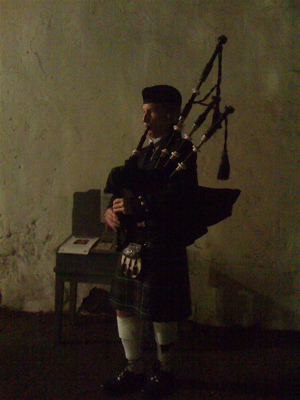
We started by buying our tickets at the Cooper Molera Adobe and then walked east to the Stevenson House, so called because Robert Luis Stevenson boarded there for almost four months one year at the turn of the last century. There, a bagpiper stood in a darkened courtyard and played stirring marches and tunes on his pipes. Inside, the house was festooned in plaid with fresh green swags of juniper. Tea and shortbread cookies were served.
Onward to the Casa Abrego and then Casa Pacheco, which was originally built by a wealthy landowner on a prime piece of property in the heart of the town then with striking views of the bay. In his day, Senior Pacheco had a clear vista from there across the harbor and near bay because fewer trees grew in town back then compared to now. It's a mens' social club and sports a rich and comfortable interior, usually only available to members. It had served as a hospital upstairs. Babies were delivered there, and it is said that three current members of the men's club (Pacheco Club) were born in the building.
The San Carlos Cathedral was next on our list, the very first cathedral built in the state. It has recently undergone a much-needed overhaul and refurbishment. Redwood tree roots and water wicking into its walls were destroying the 300-year-old structure. It has been functioning continuously ever since it was built in about 1730 and is luminous inside, its masterfully done remodel now complete. Panels in its current walls show original portions of the walls uncovered during restoration.
Other stops on our list were Colton Hall, the first capitol building in the new state of California where the state's constitution was written; The First Theater that's rarely open to the public; and Casa del Oro, also known as the Boston Store. This little store was perfumed with the old-fashioned fragrance of sarsparilla and anise-seed candies that they sell there. It is quaint and pretty. It also holds the first secure safe ever shipped to the west coast. Gold miners would bring feather quills with hollow nibs filled with gold dust and store their bounty in the safe. Thus the name of the building - House of Gold (casa del oro). There were such tidbits to be learned about each of the 22 stops on the tour. Only the most determined tour goers would stop at each place, possible if you use the full four available hours, but we only hit the high spots this year. Even so, we walked two miles on our modified route.
Last of all we hurried over to The Custom House to see its interior where docents dressed in period finery danced quadrilles and waltzes to the quaint sounds of Heartstrings, a group of musicians who play stringed instruments. The dancing, music and atmosphere held the audience spellbound. Warm applause afterward filled the room and spilled out into the plaza nearby where mist blurred distant streetlights and an ice skating rink whirling with revelers.
What makes the evening so special - and this was probably one of the most pleasant versions of the tour I've seen because the weather was so balmy - is that the lighting, the costumes, the fragrances of fresh boughs and baked goods all signal a gentle nostalgia and charm. All the adobes were decorated for the holidays, using a style typical of the early 1800s to 1880s - well, except for strings of lights here and there.
Monterey is a fine small town whose history stretches back to the times of the Rumsen people, an indigenous nation established in the area for perhaps 10,000 years before the Spanish settlers sailed into the bay in the 1600s. Their culture and society is exhibited at the Pacific House and is well worth a visit. Most of the structures open for tour tonight are part of Monterey State Historic Park Association or the California State Park system. The thousand or so people who did the walking tour gave the Park a well-deserved shot in the arm for funding. And we all were treated to a very fine experience indeed.
We started by buying our tickets at the Cooper Molera Adobe and then walked east to the Stevenson House, so called because Robert Luis Stevenson boarded there for almost four months one year at the turn of the last century. There, a bagpiper stood in a darkened courtyard and played stirring marches and tunes on his pipes. Inside, the house was festooned in plaid with fresh green swags of juniper. Tea and shortbread cookies were served.
Onward to the Casa Abrego and then Casa Pacheco, which was originally built by a wealthy landowner on a prime piece of property in the heart of the town then with striking views of the bay. In his day, Senior Pacheco had a clear vista from there across the harbor and near bay because fewer trees grew in town back then compared to now. It's a mens' social club and sports a rich and comfortable interior, usually only available to members. It had served as a hospital upstairs. Babies were delivered there, and it is said that three current members of the men's club (Pacheco Club) were born in the building.
The San Carlos Cathedral was next on our list, the very first cathedral built in the state. It has recently undergone a much-needed overhaul and refurbishment. Redwood tree roots and water wicking into its walls were destroying the 300-year-old structure. It has been functioning continuously ever since it was built in about 1730 and is luminous inside, its masterfully done remodel now complete. Panels in its current walls show original portions of the walls uncovered during restoration.
Other stops on our list were Colton Hall, the first capitol building in the new state of California where the state's constitution was written; The First Theater that's rarely open to the public; and Casa del Oro, also known as the Boston Store. This little store was perfumed with the old-fashioned fragrance of sarsparilla and anise-seed candies that they sell there. It is quaint and pretty. It also holds the first secure safe ever shipped to the west coast. Gold miners would bring feather quills with hollow nibs filled with gold dust and store their bounty in the safe. Thus the name of the building - House of Gold (casa del oro). There were such tidbits to be learned about each of the 22 stops on the tour. Only the most determined tour goers would stop at each place, possible if you use the full four available hours, but we only hit the high spots this year. Even so, we walked two miles on our modified route.
Last of all we hurried over to The Custom House to see its interior where docents dressed in period finery danced quadrilles and waltzes to the quaint sounds of Heartstrings, a group of musicians who play stringed instruments. The dancing, music and atmosphere held the audience spellbound. Warm applause afterward filled the room and spilled out into the plaza nearby where mist blurred distant streetlights and an ice skating rink whirling with revelers.
What makes the evening so special - and this was probably one of the most pleasant versions of the tour I've seen because the weather was so balmy - is that the lighting, the costumes, the fragrances of fresh boughs and baked goods all signal a gentle nostalgia and charm. All the adobes were decorated for the holidays, using a style typical of the early 1800s to 1880s - well, except for strings of lights here and there.
Monterey is a fine small town whose history stretches back to the times of the Rumsen people, an indigenous nation established in the area for perhaps 10,000 years before the Spanish settlers sailed into the bay in the 1600s. Their culture and society is exhibited at the Pacific House and is well worth a visit. Most of the structures open for tour tonight are part of Monterey State Historic Park Association or the California State Park system. The thousand or so people who did the walking tour gave the Park a well-deserved shot in the arm for funding. And we all were treated to a very fine experience indeed.
Subscribe to:
Posts (Atom)


